Nearly 90% of U.S. Adults Meet Criteria for CKM Syndrome Under the New Multi-Society Guideline
The AHA, ACC, ADA, and ASN released their first joint clinical guideline on Cardiovascular-Kidney-Metabolic syndrome in June 2026. The epidemiology behind it is staggering: nearly 90% of US adults meet criteria for CKM stage 1+, mortality climbs nearly 5x from stage 0 to stage 4, and chronic kidney disease — affecting roughly 37 million Americans — sits at the structural core of the framework.
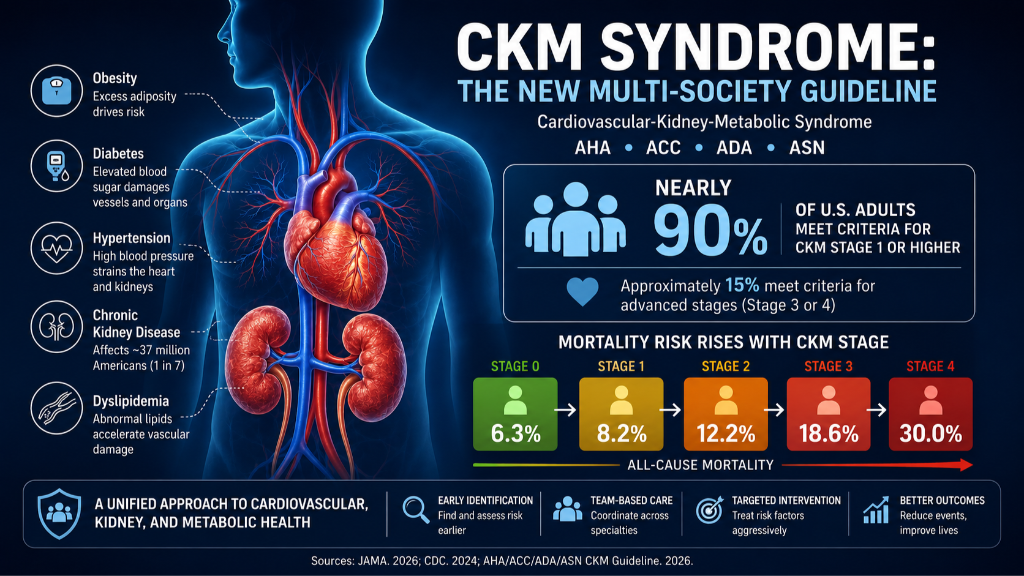
In June 2026, the American Heart Association, American College of Cardiology, American Diabetes Association, and American Society of Nephrology released their first-ever joint clinical guideline on Cardiovascular-Kidney-Metabolic (CKM) syndrome — codifying a framework the AHA first proposed in a 2023 presidential advisory into formal, actionable clinical practice. The underlying epidemiology is what makes this more than a paperwork exercise: this may represent the most common clinical risk framework in American medicine, and chronic kidney disease occupies a uniquely important role within it.
The numbers are larger than almost any other disease category
A study published in JAMA using NHANES data found that nearly 90% of US adults meet criteria for CKM syndrome stage 1 or higher, and approximately 15% meet criteria for the advanced stages (3 or 4) — where subclinical or clinical cardiovascular disease has already developed. A separate analysis tracking the same population over time found CKM prevalence rose from 76.5% in 2001-2004 to 82.2% by 2017-2020, with a corresponding decline in the healthiest stage-0 and stage-1 categories — meaning the population is trending toward more advanced disease stages over time, not fewer.
Mortality data validates the staging system's clinical relevance: observed all-cause mortality climbs consistently with CKM stage, from roughly 6.3% at stage 0 up to roughly 30% at stage 4, according to a stage-stratified mortality analysis. That's a nearly 5x mortality gradient across the staging system — a strong signal that this isn't an arbitrary classification scheme, but one that tracks real biological risk.
Where CKD fits — and why it's not just "one of five" factors
Chronic kidney disease deserves particular attention within the CKM framework because of its scale and its silent nature. The CDC estimates roughly 37 million US adults — about 14%, or 1 in 7 — have CKD, and a large share are undiagnosed because early-stage kidney disease typically produces no symptoms. CKD becomes a defining component beginning in Stage 2 (via reduced kidney function or the presence of albuminuria — protein in the urine, an early kidney damage marker). Certain high-risk CKD findings can independently qualify a patient for Stage 3, even in the absence of clinical cardiovascular disease.
This matters clinically because kidney function decline and cardiovascular risk share biological machinery — vascular inflammation, fluid and sodium regulation, and the renin-angiotensin-aldosterone system — such that damage to one accelerates damage to the other. CKD occupies a uniquely important role within the CKM framework because it both reflects systemic vascular injury and accelerates progression toward cardiovascular disease.
The skeptical read
A framework covering 90% of the adult population invites an obvious question: is "CKM syndrome" a genuinely useful clinical construct, or is it medicalizing common cardiometabolic risk factors? The mortality gradient data is the strongest counterargument — a nearly 5x difference in mortality risk between stage 0 and stage 4 isn't statistical noise, and the staging system's core value proposition is catching patients in Stages 1-2, before subclinical damage (Stage 3) or a cardiovascular event (Stage 4) occurs, when intervention is cheapest and most effective.
For decades, cardiology, nephrology, endocrinology, and primary care largely treated these diseases as separate conditions. The 2026 guideline reflects growing evidence that they represent interconnected manifestations of the same underlying biology, requiring coordinated rather than sequential care.
The more legitimate critique is operational, not scientific: a framework this broad requires primary care physicians, cardiologists, nephrologists, and endocrinologists to actually coordinate care in a health system that has historically siloed them. The 2026 guideline explicitly calls for interdisciplinary care teams and addressing social determinants of health — the right prescription on paper, but implementation at scale, across a population this large, is the part that will take years, not a guideline release, to actually prove out.
Todd Colpron is the Managing Partner of Eliakim Capital, a boutique principal investment and strategic advisory firm focused on life sciences, capital strategy, and long-term value creation. He works with select management teams navigating growth, investor communications, and capital formation, while evaluating opportunities where Eliakim Capital’s experience, relationships, and investment perspective can add meaningful value. The firm may also invest its own capital when an opportunity demonstrates strong strategic alignment and investment merit.