Intelligence Archive
Analysis & Intelligence
Analysis on the companies, policies, technologies, and capital flows shaping the biotech economy.
25 articles · sorted by most recent
Samsung Just Paid $1.8 Billion for a Peptide Factory. Here's What That Tells You About the Market.
Samsung Biologics' all-cash acquisition of PolyPeptide Group — the largest South Korean biopharma deal ever — signals that peptide manufacturing capacity, not discovery, is the binding constraint on the GLP-1 era. Same week, Bachem dropped $615M on a new Swiss facility. The picks-and-shovels play in peptides is accelerating.
High-Conviction Early Stage / Academic Darling
The Disease That Affects 9 in 10 American Adults — And Why Cardiology, Nephrology, and Metabolic Medicine Just Agreed to Stop Treating It Separately
An estimated 90 percent of U.S. adults meet the criteria for cardiovascular-kidney-metabolic (CKM) syndrome. In 2023, the AHA formally defined it. In 2026, four major medical societies issued the first joint treatment guideline. What was once four separate diseases is now understood as a single, interconnected — and potentially reversible — condition.
High-Conviction Early Stage / Academic Darling
The Hidden Approval Bottleneck in Cell and Gene Therapy Is Manufacturing—and FDA Is Trying to Make It Less Rigid
On May 5, 2026, the FDA's Office of Therapeutic Products published a direct-to-final guidance formalizing how it applies chemistry, manufacturing, and controls (CMC) flexibilities to cell and gene therapy products heading toward a Biologics License Application. The 10-page document puts into writing what CBER reviewers have been doing case-by-case for years: accepting fewer PPQ batches, permissive release specs for early-stage products, risk-based comparability, and leveraging CMC knowledge across similar products. The legal requirements haven't changed. But the clarity—and the message to every sponsor, not just the ones who knew who to ask—could meaningfully shorten development timelines for the most complex therapies in medicine.
Regulatory Inflection / Platform Infrastructure
The FDA Just Opened the Door to Six Unapproved Peptides. Here's What That Really Means.
On July 23-24, 2026, the FDA's Pharmacy Compounding Advisory Committee voted to recommend six peptides — BPC-157, KPV, TB-500, MOTS-c, Semax, and Epitalon — for the 503A Bulks List, allowing compounding pharmacies to legally produce them. The vote overrode unanimous opposition from the agency's own scientists and was championed by Health Secretary RFK Jr. But compounding is not approval. The distinction matters — and so does the $100 million gray market it could replace.
Regulatory Inflection / Early-Stage Controversy
The Peptide Pivot: Why Pharma Is Moving From Masking Disease to Solving It
For decades, small molecules dominated drug development — elegant chemistry that blocked receptors, inhibited enzymes, and suppressed symptoms. Now a $140 billion peptide therapeutics market is rewriting the playbook. Peptides sit in the Goldilocks zone between small molecules and biologics: specific enough to engage complex protein-protein interactions, small enough to penetrate tissues and cross barriers, and versatile enough to be conjugated to radionuclides, toxins, and drug payloads. The shift from masking disease to solving it at the pathway level may be the most important structural change in pharmaceutical R&D since the introduction of monoclonal antibodies.
High-Conviction Structural Shift / Platform Thesis
The Twice-Rejected Oncolytic Virus That Could Rewrite Melanoma Treatment
Replimune's RP1 — an engineered herpes virus that kills melanoma cells from the inside — was rejected by the FDA twice. After a 10-3 advisory committee vote and a third resubmission, the agency's decision is imminent. The saga reveals a deeper debate about how the FDA evaluates single-arm trials, oncolytic virus platforms, and treatments for patients with no other options.
High-Conviction Early Stage / Regulatory Inflection
Medicare Just Opened the GLP-1 Floodgates. Here's What It Means for the Market
On July 1, CMS launched the Medicare GLP-1 Bridge — a time-limited demonstration program covering obesity drugs for the first time in Medicare's history. Several million seniors are eligible. Novo Nordisk and Eli Lilly secured a $245 net price. The fiscal and market implications are enormous — and the clock is ticking.
Late-Stage De-risked / Blockbuster Potential
The Biotech Funding Gap Is Widening — and It's Not Coming Back
Biotech VC hit a multi-year high in H1 2026, but the money is going to the same handful of late-stage mega-caps. Early-stage startups are being starved out, and the structural forces driving the gap aren't temporary.
Market Analysis / Sector Signal
FDA Approves Tregzi: The First Regulatory T Cell Therapy, and a 78% vs. 38% Phase 3 Result That Redefines Transplant Medicine
The FDA approved Tregzi on June 30, 2026 — the first precision-engineered regulatory T cell therapy ever authorized. In a randomized Phase 3 trial in blood cancer patients undergoing allogeneic stem cell transplant, Tregzi achieved 78% one-year cGVHD-free survival versus 38% with standard of care, with 94% overall survival versus 83%. The data doesn't just improve on the existing standard — it reframes what the standard should be.
Late-Stage De-risked / Blockbuster Potential
The GLP-1 Drugs Have a Muscle Problem. Biohaven Thinks It Has the Fix.
Up to 40% of weight lost on GLP-1 drugs like semaglutide comes from lean muscle mass — a growing clinical concern for older patients and long-term users. Biohaven's taldefgrobep alfa, a myostatin-activin pathway inhibitor with a clean 700-patient safety record, just completed Phase 2 enrollment targeting fat loss with simultaneous muscle preservation. Phase 2 topline data expected 2H 2026 could reframe the obesity drug conversation.
High-Conviction Early Stage / Academic Darling
Scientists Just Injected a Human with a Therapy Designed to Make Aging Cells Young Again
On June 9, 2026, a person received the world's first injection of a partial cellular reprogramming therapy — ER-100, built by Life Biosciences on David Sinclair's Harvard research. Using three Yamanaka factors to reset the epigenetic clock without erasing cell identity, the Phase 1 trial targets age-related vision loss. It is also the opening shot of an entirely new category of medicine.
High-Conviction Early Stage / Academic Darling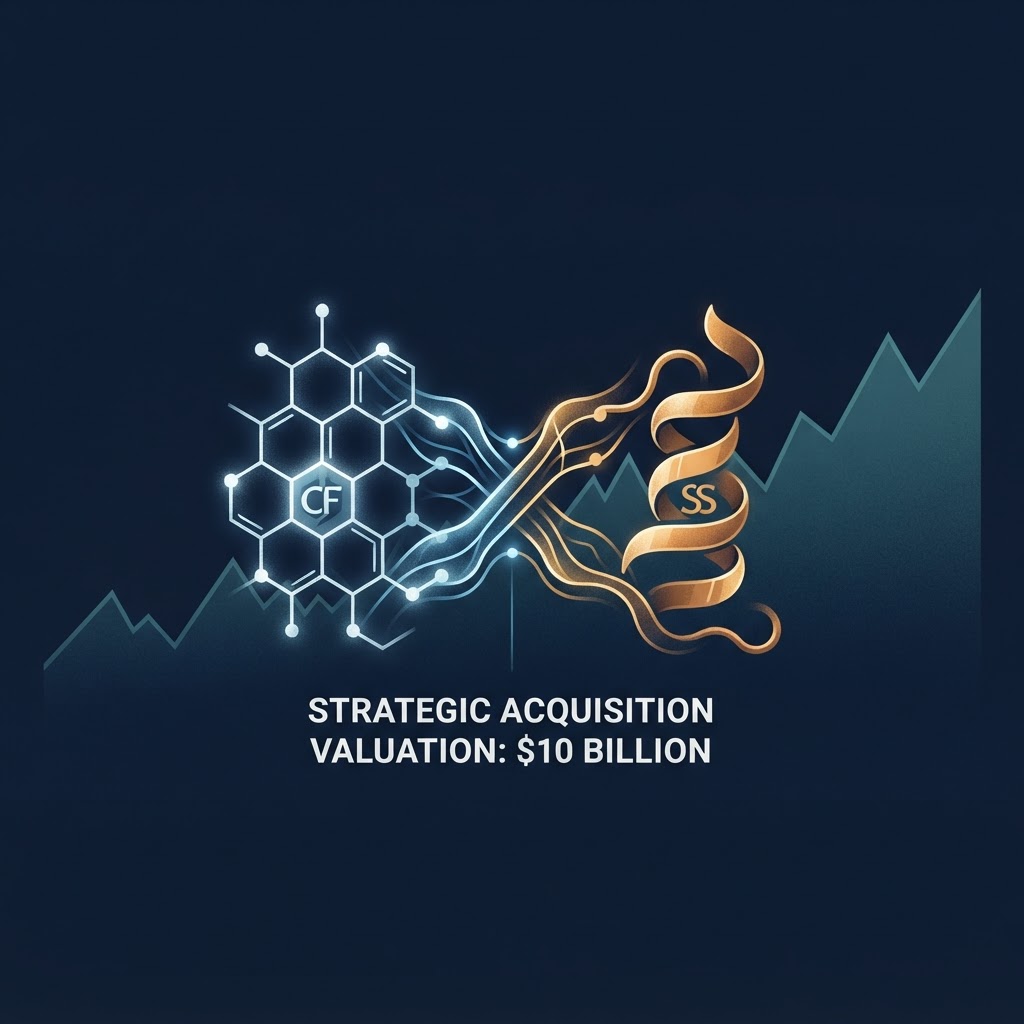
Vertex Pays $10B for Crinetics — Its Largest Deal Ever and the Blueprint for Its Next Decade
Vertex Pharmaceuticals' $10 billion acquisition of Crinetics adds a launched acromegaly drug and a Phase 3 CAH blockbuster candidate — and signals exactly how the CF giant plans to sustain growth beyond its core franchise. The deal is the fourth $10B+ transaction in a 2026 M&A supercycle already at $134 billion.
Late-Stage De-risked / Blockbuster Potential
AstraZeneca & Ionis Stumble: Eplontersen Misses Primary Endpoint in Landmark ATTR-CM Trial
The largest ATTR-CM trial ever conducted — 1,432 patients, 140 weeks, 130 sites across 20 countries — just missed its primary endpoint. But the failure of eplontersen in CARDIO-TTRansform is less a story about a bad drug and more a story about a field that moved faster than the trial designed to test it.
Binary Gamble / Regulatory Risk
Vertex's $10 Billion Crinetics Deal: A De-Risked Bet on Life After Cystic Fibrosis
Vertex Pharmaceuticals is acquiring Crinetics Pharmaceuticals for $10 billion -- the largest deal in Vertex's history -- gaining an FDA-approved oral acromegaly drug and a Phase 3 congenital adrenal hyperplasia candidate. It's a genuinely de-risked acquisition by biotech M&A standards, and a clear signal Vertex's diversification beyond cystic fibrosis has moved from pipeline bets to M&A.
Late-Stage De-risked / Blockbuster Potential
The Biologics Revolution: How Peptides, Semaglutide, and a Radical New Science Are Rewriting Pharma
Biologics now make up roughly half of the industry's active drug pipeline, and semaglutide's FLOW trial kidney data is the strongest proof yet of what they can do that small molecules can't. Here's the capital markets case for the biologics shift -- and where the hype needs a discipline check.
Late-Stage De-risked / Blockbuster Potential
Sandoz Just Filed the First Generic Tirzepatide Challenge — Here's Why Cheap Mounjaro Is Still Years Away
The FDA accepted Sandoz's ANDA filings for generic tirzepatide on June 29, 2026 — the first such challenge against Eli Lilly's Mounjaro/Zepbound franchise. But Lilly's primary compound patent doesn't expire until 2036, meaning this is the opening move in a multi-year Paragraph IV-style patent fight, not a signal that cheap tirzepatide is imminent.
Speculative / Concept Stage
The Drugs Built for CKM: How GLP-1s, SGLT2 Inhibitors, and Finerenone Are Rewriting Cardio-Renal-Metabolic Care
Three drug classes developed for diabetes — GLP-1 receptor agonists, SGLT2 inhibitors, and finerenone — are now formally recommended first-line therapies across the new CKM syndrome guideline. The FLOW trial proved semaglutide protects kidneys and hearts independent of blood sugar control. Here's the clinical evidence, and the commercial market-expansion story behind it.
Late-Stage De-risked / Blockbuster Potential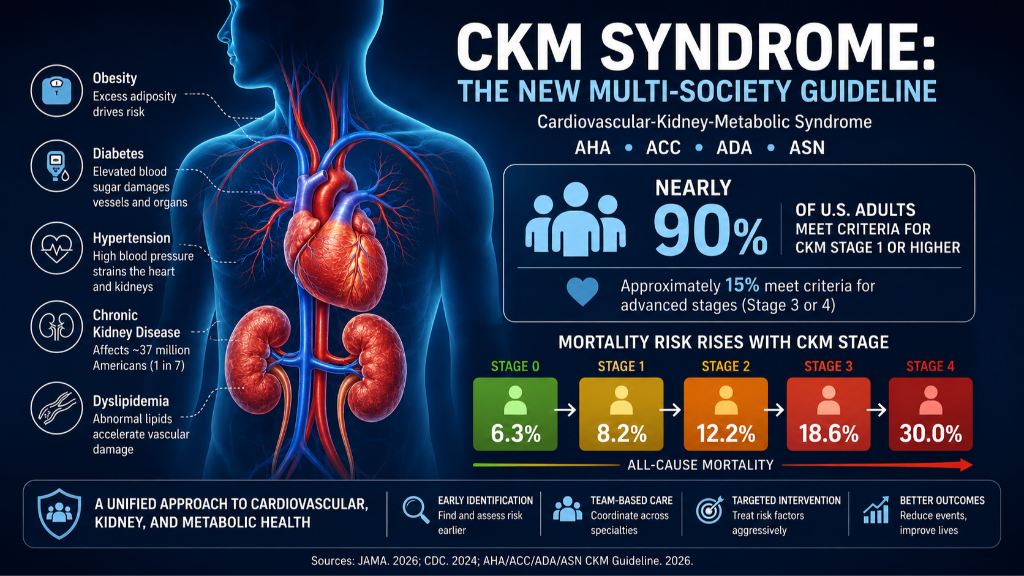
Nearly 90% of U.S. Adults Meet Criteria for CKM Syndrome Under the New Multi-Society Guideline
The AHA, ACC, ADA, and ASN released their first joint clinical guideline on Cardiovascular-Kidney-Metabolic syndrome in June 2026. The epidemiology behind it is staggering: nearly 90% of US adults meet criteria for CKM stage 1+, mortality climbs nearly 5x from stage 0 to stage 4, and chronic kidney disease — affecting roughly 37 million Americans — sits at the structural core of the framework.
Late-Stage De-risked / Blockbuster Potential
What Is CKM Syndrome? And How Does Kidney Disease Fit In?
CKM syndrome — Cardiovascular-Kidney-Metabolic syndrome — is a new framework linking heart disease, kidney disease, and metabolic conditions like obesity and diabetes into one connected system. Chronic Kidney Disease isn't separate from CKM; it's one of its core building blocks. Here's the 5-stage system explained in plain English.
Late-Stage De-risked / Blockbuster Potential
AI for Biologics R&D: What's Actually Working, and Where the Evidence Runs Out
AI-discovered drugs are passing Phase I at 80-90% versus a 40-52% historical average, and generative antibody design (Chai-2, Isomorphic's IsoDDE) is real technical progress. But as of mid-2026, zero AI-discovered drugs have FDA approval, and Phase II/III — where efficacy actually gets tested — still shows no clear AI advantage. Here's the evidence, company by company.
High-Conviction Early Stage / Academic Darling
Cellares Just Dosed Its First Patients on a Fully Automated CAR-T Line — Here's Why That's a Bigger Deal Than It Sounds
Cellares dosed the first patients with a CAR-T therapy manufactured entirely on its automated Cell Shuttle platform, targeting the manufacturing bottleneck that's kept cell therapy costs high and patient access low for a decade. BMS, Cabaletta Bio, and a fresh $327M Series D suggest this is more than a one-off proof of concept — but the real cost-reduction claims still need commercial-scale proof.
High-Conviction Early Stage / Academic Darling
Casgevy Expands to Children as Young as 2 — What the CRISPR Milestone Actually Means
The FDA expanded Casgevy, the first approved CRISPR/Cas9 gene therapy, to sickle cell and beta thalassemia patients as young as 2 years old. It's a real clinical win for early intervention — but three years post-launch, patient numbers remain in the hundreds, and the real bottleneck is treatment infrastructure, not the science.
High-Conviction Early Stage / Academic Darling
How Indianapolis Quietly Built One of the World's Deepest Biologics Ecosystems
From the first commercial insulin to Humalog to the GLP-1 revolution, Indianapolis has produced century-defining biotech breakthroughs — and generated more than $100 billion in philanthropic capital along the way. The story of Richard DiMarchi, Eli Lilly, and a city that compounded scientific talent across generations.
High-Conviction Early Stage / Academic Darling
The Peptide Gray Zone: What's Actually Legal, What's Actually Safe, and Why RFK Jr. Just Overruled His Own FDA
Peptide therapeutics are a $140B market, but the peptides everyone's talking about online — BPC-157, TB-500, melanotan II — aren't FDA-approved for humans. Now HHS Secretary RFK Jr. is personally reversing a 2023 FDA safety determination, over the objections of the officials who wrote it.
Late-Stage De-risked / Blockbuster Potential
Cure All Disease in a Decade? Here's What AI Has Actually Delivered So Far
DeepMind's Demis Hassabis says AI could cure all disease within a decade. We checked the actual evidence — AlphaFold's Nobel Prize, an AI-discovered drug's phase 2a trial, a dog longevity drug's FDA milestone, and Bryan Johnson's self-experiments — against the claim.
Late-Stage De-risked / Blockbuster Potential